The uncomfortable truth
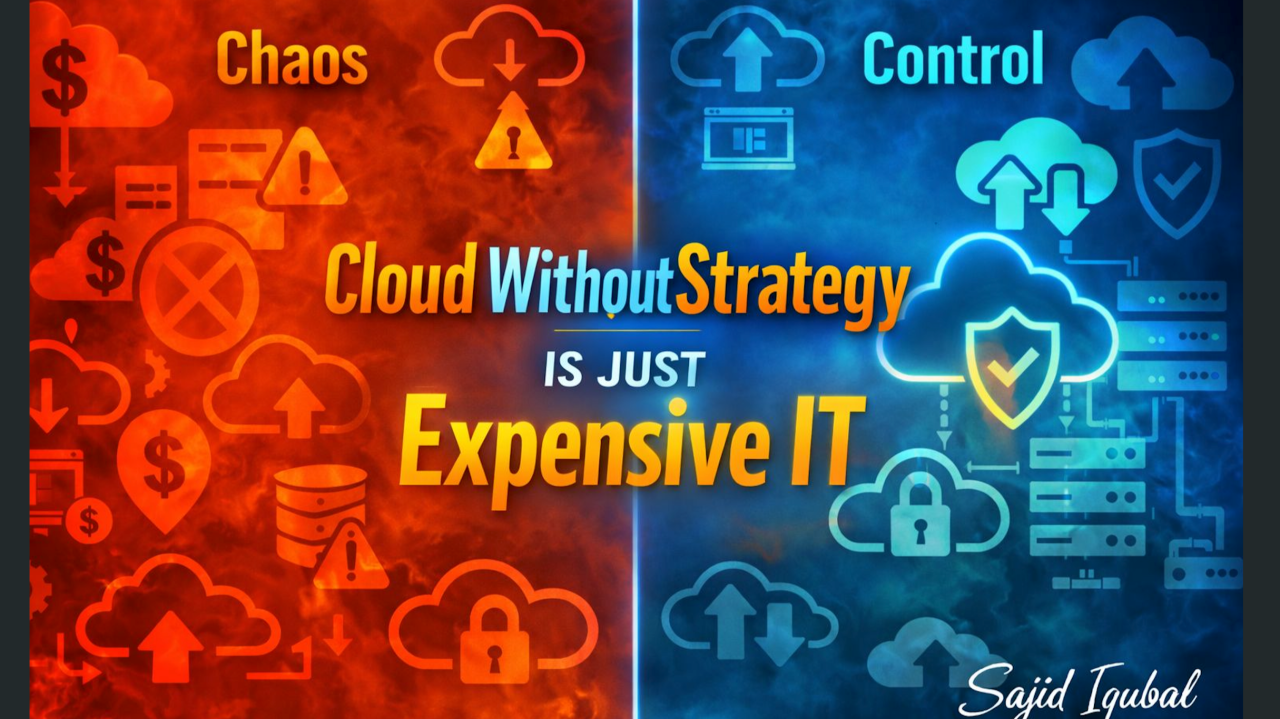
Let me start with a conversation I’ve had more than once with senior leaders across the Kingdom. “We moved to the cloud to save cost… so why are we spending more?” Cloud doesn’t reduce cost by default. Cloud amplifies whatever discipline or lack of discipline you already have.
Globally, cloud adoption is accelerating across industries, driven by hyperscalers such as AWS, Microsoft Azure, Google Cloud, Oracle Cloud and Alibaba. While enterprises are rapidly modernizing their infrastructure, many still struggle to define a clear cloud strategy that is tightly aligned with business value, governance, and financial outcomes.
“The issue is rarely the cloud itself. It’s the absence of a clear, disciplined strategy."
Where Things Go Wrong
Too often, organizations treat cloud migration as a lift-and-shift exercise moving workloads as is without rethinking architecture, operations, or cost structures.
The result is predictable:
- Overprovisioned resources
- Idle environments running unchecked
- Limited visibility into actual consumption
- Inefficient architectural patterns, carrying forward legacy designs that are not cloud-native
- Absence of governance and guardrails, leading to inconsistent provisioning and policy drift
- Uncontrolled multi-cloud sprawl, increasing complexity without clear strategic intent
- Failure to align spend with business outcomes, resulting in high cost but low measurable value
- Underutilization of pricing models, such as spot and commitment-based options
Individually, these inefficiencies seem manageable. Collectively, they create sustained cost overruns and operational friction.
The Mindset Shift
Leading organizations approach the cloud differently. They recognize it not just as infrastructure, but as a strategic and financial enabler.
They focus on:
- Cost per transaction, not just total spend
- Alignment between technology investment and business outcomes
- Scalability that is both elastic and efficient
In this model, success is not defined by migration milestones but by measurable business value.
Cloud Strategy in Practice
A strong cloud strategy is built on disciplined execution:
- Visibility:End-to-end insight into workloads, usage, and spend
- Accountability:Clear ownership across engineering, operations, and finance
- Unit Economics:Understanding the true cost drivers of services
- Commercial Optimization:Leveraging commitment-based pricing models effectively
- Elastic Design: Architecting systems to scale dynamically with demand
This is where strategy moves from intent to impact.
Cost Optimization That Works
Cost optimization is not a one-time initiative. it is an ongoing capability.
High-performing organizations focus on:
- Rightsizing infrastructure based on actual workload demand and usage patterns
- Eliminating idle and underutilized resources to prevent unnecessary spend
- Adopt commitment-based pricing models for predictable, steady-state workloads to optimize long-term spend
- Scheduling non-production environments (development, test, and staging) to automatically shut down during non-working hours or when not in use
- Adopt spot instances for fault-tolerant architectures, particularly across non-production and temporary workloads, to drive substantial compute cost efficiency
- Implementing intelligent storage tiering to align cost with data access frequency and business value
- Continuously monitoring and optimizing usage in near real time through automation and policy-driven controls
This is not simply about reducing cost.it’s about building a system where efficiency is continuous, measurable, and aligned with business outcomes.
The Multi-Cloud Reality
Multi-cloud strategies are increasingly common but often poorly executed.
Without clear intent and governance, multi-cloud environments lead to:
- Fragmentation
- Increased operational complexity
- Higher, less predictable costs
A successful multi-cloud approach is deliberate, with strong controls and a clear understanding of where and why each platform is used.
The Operating Model
Ultimately, cloud success is driven by how organizations operate.
High performing enterprises:
- Adopt FinOpsto align finance, technology, and business teams
- Standardize platforms to reduce complexity and increase efficiency
- Provide executive-level visibilityinto cloud consumption, cost, and value
Cloud excellence is not accidental it is operationalized.
Conclusion
Cloud is not a strategy in itself it is an enabler.
Without clear architecture, governance, and financial discipline, it inevitably becomes expensive IT at scale. However, when designed and operated with intent, it transforms into a powerful driver of innovation, efficiency, and sustainable business growth.