Introduction
In today’s digital world, downtime or data loss can directly impact business reputation, revenue, and customer trust. IT leaders often hear the terms High Availability (HA), Disaster Recovery (DR), and Backup, but these concepts are frequently misunderstood or used interchangeably. While all three aim to ensure business continuity, they address different challenges and operate at different layers of IT resilience.
This post explains the differences between DR, HA, and Backup with definitions, use cases, and a technical comparison table so IT professionals can clearly understand when and how each should be applied.
1. High Availability (HA)
- Definition: Architectural design that ensures services remain accessible with minimal disruption, even during component failures.
- Approach: Achieved using clustering, load balancing, fault tolerance, redundant power/network, and active-active/active-passive configurations.
- Goal: Eliminate single points of failure and minimize downtime.
- RTO/RPO: Near-zero RTO, near-zero RPO.
Why it matters:
- Enables continuity of critical operations, including banking transactions, ERP/CRM systems, and SaaS platforms
- Protects national databases, defence systems, and logistics operations during crises
- Minimizes business disruption and ensures operational resilience
HA is the first line of defense against downtime, protecting revenue and reputation by preventing service interruptions.
2. Disaster Recovery (DR)
- Definition: Policies, tools, and processes to recover IT services after catastrophic events (natural disaster, data center outage, cyberattack).
- Approach: Includes replication to secondary sites (hot, warm, cold), cloud-based DRaaS, automated orchestration, and periodic DR drills.
- Goal: Restore IT operations within defined Recovery Time Objective (RTO) and Recovery Point Objective (RPO).
- RTO/RPO: RTO: hours–days; RPO: minutes–hours (depending on solution).
Why it matters:
- Enables continuity of critical operations, including banking transactions, ERP/CRM systems, and SaaS platforms
- Protects national databases, defence systems, and logistics operations during crises
- Minimizes business disruption and ensures operational resilience
While HA prevents downtime, DR ensures the business can bounce back quickly when disaster strikes.
3. Backup
- Definition: Process of making periodic copies of data to protect against corruption, accidental deletion, or ransomware.
- Approach: Can be file-level, block-level, or image-based; stored on disk, tape, or cloud; often includes immutability for ransomware protection.
- Goal: Ensure point-in-time recovery of data and compliance with data retention policies.
- RTO/RPO: RTO: hours–days; RPO: hours–days.
Why it matters:
- Restores servers, databases, and endpoints when data is lost or compromised
- Preserves intellectual property, R&D data, and regulatory records
- Supports audit requirements and long-term data retention
Even a DR site requires backups, because while DR ensures availability, backups protect the integrity and history of your data.
4. Use Cases
In the modern digital landscape, businesses cannot afford downtime or data loss. IT leaders need to clearly understand High Availability (HA), Disaster Recovery (DR), and Backup to ensure continuous operations, safeguard data, and meet compliance requirements. Each approach addresses different risks and provides distinct value to the organization.
High Availability (HA) Use Case:
High Availability ensures that critical applications and services remain operational at all times, minimizing interruptions and service downtime.
- Ensures critical services remain operational without interruption
- Ideal for financial transactions and core banking platforms
- Supports customer-facing portals and e-commerce systems
- Maintains real-time ERP and trading systems
- Critical for healthcare monitoring systems
- Essential for airline booking and reservation systems
- Prevents downtime and ensures business continuity
Disaster Recovery (DR) Use Case :
Disaster Recovery focuses on quickly restoring IT systems after major incidents or disasters, ensuring business continuity during catastrophic events.
- Enables rapid recovery of IT systems after catastrophic events
- Covers data center failures, cyberattacks, or regional outages
- Essential for core banking operations and transaction systems
- Supports ERP/CRM applications and SaaS platforms
- Critical for defence systems and national databases
- Minimizes business disruption and ensures operational resilience
Backup Use Case :
Backup provides point-in-time copies of data, protecting organizations from data loss, corruption, or ransomware, and supporting compliance and audits.
- Provides point-in-time copies of data for recovery
- Protects against accidental deletion, corruption, or ransomware
- Critical for servers, databases, and intellectual property
- Secures R&D data, banking logs, and national records
- Supports compliance, audit requirements, and long-term data preservation
Technical Comparison Table:

Conclusion
Ensuring business continuity requires a clear understanding of High Availability (HA), Disaster Recovery (DR), and Backup.
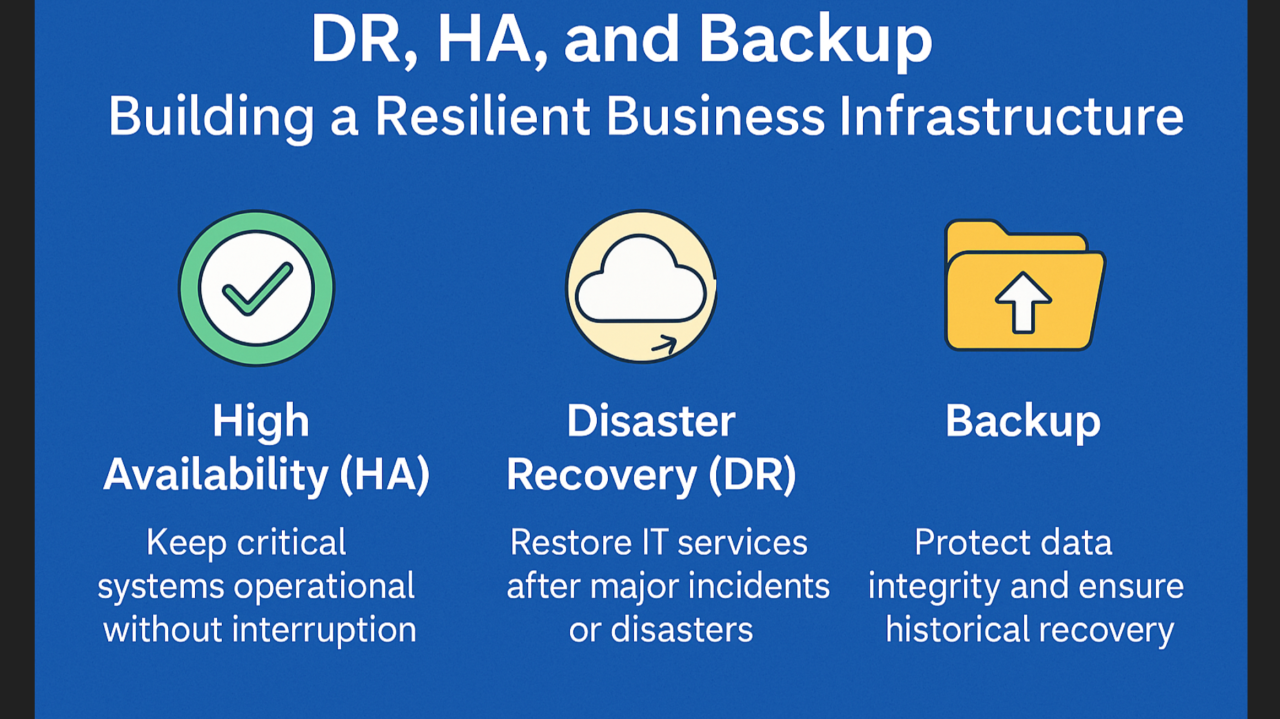
- HA keeps critical systems running without interruption.
- DR enables rapid recovery after major incidents or disasters.
- Backup protects data integrity and ensures historical recovery.
Together, these strategies provide a comprehensive approach to resilience, safeguarding operations, data, and customer trust. For executives, investing in HA, DR, and Backup is not just an IT decision—it’s a strategic business imperative.