Most of us spent the middle of November watching other people’s cloud outages. Microsoft 365 went down for the best part of a day. Two days later, AWS had an identity problem in its busiest region that hardly anyone outside engineering teams noticed. And in between, the US grounded every departing flight for over four hours because of a network change at two remote radio sites.
None of it was a cyberattack. That is the part I keep coming back to. These were ordinary changes, ordinary maintenance and ordinary failovers that lined up in the wrong order. If that can happen to the largest platforms on the planet, it can happen to the ones your business runs on.
I want to walk through what actually went wrong, and then what I think it means for each of us, whether you sit in the boardroom, run an IT department, manage operations day to day, or design the architecture.
A quick recap of what broke
Microsoft 365, 12–13 November. For roughly 24 hours, a lot of people could not reach their Exchange Online mailboxes, and Teams, SharePoint, OneDrive and Copilot all felt it. According to Microsoft’s own post-incident report, the root cause was a bug introduced in a July update to its gateway servers. It sat quietly in production for months. Then three things happened together: part of the gateway fleet was offline for planned maintenance, a Teams failover pushed extra traffic onto gateways shared with Exchange, and normal peak load arrived. Most of the gateways stopped responding. Microsoft was also open about the fact that its load tests had run on older hardware, which is why the bug didn’t show up in testing, and it has published a clear plan to fix that.
AWS us-east-1, 15 November. Early on a Sunday morning (Pacific time), AWS saw sign-in and connectivity errors, with IAM Identity Center hit hardest. It took a few hours to clear. Because the people affected were mostly engineers trying to log in to consoles, rather than customers using apps, it barely made the news.
FAA ground stop, 13 November. Not a cloud story, but the same shape. An equipment upgrade by a contractor flooded the air traffic telecom network with connection requests, and legacy equipment at most en route centers struggled to cope.
Forrester’s analysis of the month pointed to technical debt, tightly coupled systems and too much risk concentrated in too few places, rather than any kind of attack. I agree, and I think it is the most useful framing for anyone planning disaster recovery right now.
Why this matters here in the Kingdom
Cloud adoption in Saudi Arabia is moving quickly, and that is a good thing. Microsoft said its new Saudi Arabia East region, with three availability zones in the Eastern Province, would open to customers this month. Together with the other hyperscaler and local options, organizations now have real choices for keeping data in the country.
But I hear one assumption a lot in conversations with customers: “We are in a local region with multiple availability zones, so we are covered.” Availability zones protect you when a data center has a bad day. They do not protect you when a global service such as identity, email routing or a shared gateway fails. November’s incidents were exactly that kind of failure. Being in Riyadh or Dammam would not have helped.
What I would do next, depending on your role
For CXOs
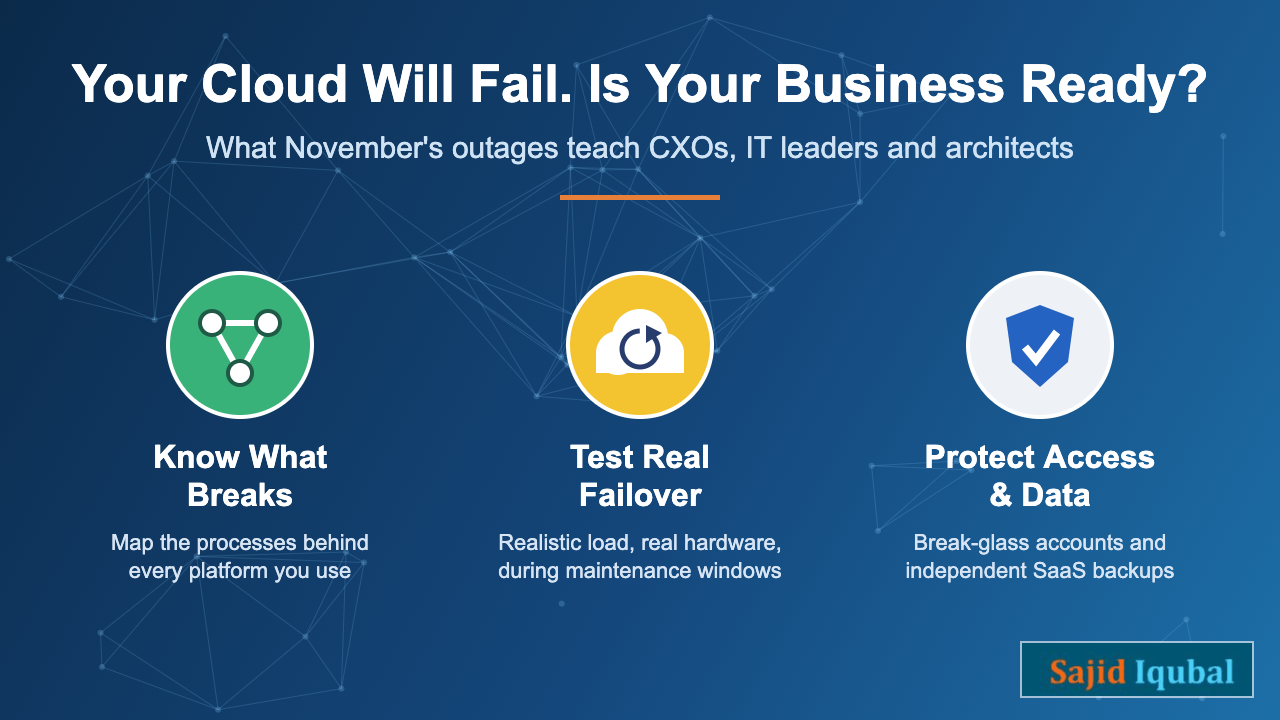
Ask one simple question at your next leadership meeting: “If email and Teams disappeared for a full working day, what would stop?” You will probably hear about approvals that live in mailboxes, customer updates that go out by email, and finance processes that depend on shared files. That list is your real business impact assessment. Treat concentration on a single provider as a business risk that belongs on the risk register, not just an IT detail.
For IT Directors
Look at your DR plan and check whether it only covers “our data center is down” scenarios. Add a section for “our SaaS or cloud platform is down, and we can’t fix it.” Decide in advance what the fallback is for communication, who declares the incident, and how you update staff and customers. Then make your providers’ post-incident reports a regular part of your partnership reviews. They are usually detailed and generous with lessons, and they help you ask good questions about change testing, rollback and incident communication.
For IT Managers
Check your break-glass accounts this week. Can your team get into the cloud console if your normal single sign-on path is down? Are those credentials stored somewhere you can reach during an outage, and has anyone actually tested them recently? Also make sure you have an independent backup of Microsoft 365 or Google Workspace data. The provider keeps the platform running; keeping your data reachable is still your job.
For Architects
The Microsoft incident is a useful example of how failover itself can add pressure. Automated traffic shifting moved load onto servers that were already struggling and made things worse. When you design failover, ask what the receiving side can actually absorb, especially during maintenance windows when capacity is already reduced. Map shared components that sit underneath several services, because that is where one fault becomes five. And when you run DR tests, run them under realistic load, on the hardware you actually use in production, not on a quiet Friday afternoon.
A simple way to think about it
I find it helps to split failures into three levels, because each one needs a different answer. (If you want a refresher on how high availability, disaster recovery and backup differ, I covered that in DR, HA, and Backup: Building a Resilient Business Infrastructure.)
| What fails | Typical example | What actually helps |
|---|---|---|
| One zone | Power or cooling issue in a single data center | Multi-AZ design, load balancing, clustering |
| One region | A regional network or service disruption | Cross-region replication and a tested DR runbook |
| The platform itself | A global identity or email gateway failure | Independent backups, a second communication channel, break-glass access and manual workarounds |
Most organizations I work with have the first row well covered, the second row partly covered, and the third row not covered at all.
The unglamorous work wins
The hyperscalers invest heavily in reliability and are still far more resilient than most on-premises setups, and I remain a strong believer in cloud-first strategies. The transparency of their post-incident reports is something the whole industry benefits from. But November was a reminder that resilience is not something you buy with a region or a contract. It comes from boring, steady work: knowing your dependencies, testing for the failures that really happen, and making sure your people can keep working when a platform they rely on can’t.
If you only do one thing this month, pick one critical business process and walk through what happens if its main platform disappears for a day. That one hour will tell you a lot about where you really stand.
I would love to hear how your teams handled the Microsoft outage. What held up, and what surprised you?
Sources
- The Register: Microsoft’s final report on the November outage
- The Register: The AWS outage you didn’t hear about
- WindowsForum: Forrester on the November outages and technical debt
- Microsoft: Saudi Arabia East datacenter region announcement
Disclaimer: This article is for educational and informational purposes only. It reflects my personal views and not those of my employer or any organization I am associated with. Content is based on publicly available information at the time of writing and does not constitute professional, legal or investment advice. All product names, logos and brands are the property of their respective owners and are mentioned for identification only. Readers should seek appropriate professional advice before making decisions based on this content.